NASA Langley Tours
A Brief History of NASA Langley
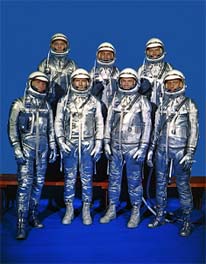 |
NASA’s Langley Research Center was the original NACA (National Advisory Committee for Aeronautics) center when the agency was first created in 1917. During its time as NACA, Langley was home to the first wind tunnels, leading the way in flight research from the very beginning. Since its creation, Langley has been a significant contributor to the advancement of our nation’s aerospace technology. From its initial contributions to wind tunnel research to its support of the first lunar landing to its part in the X-vehicle research programs, NASA Langley has clearly played an integral part in bringing the aerospace industry to where it is today. |
| Along with the other NASA centers, Langley continues to be on the forefront of the aerospace industry to this day. Langley leads NASA in aviation safety, quiet aircraft technology, small aircraft transportation, and aerospace vehicles system technology, and it supports NASA space programs with atmospheric research and technology testing and development. With its continuing work on projects such as the morphing wing aircraft, personal air vehicles, and space exploration missions, Langley will help to lead our nation into the next era of flight. | 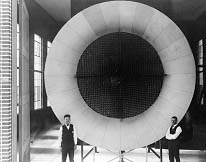 |
http://grin.hq.nasa.gov/BROWSE/LARC_1.html Identical tours of the center will be offered on Tuesday, August 19th at 8:00am and Wednesday, August 20th at 1:30pm. The tour will last approximately 3.5 hours. A NASA Langley bus will be picking up participants at the gate and driving to all stops on the tour. When registering for the conference, please indicate which day you would like to attend. If you are a U.S. citizen, and you indicate on your registration that you would like to attend a tour, you will be registered automatically for access to NASA Langley on the specified day. If you are not a U.S. citizen, please fill out the form below no later than Monday, July 28 so that we may process the request for your access to the center. Foreign
Visitor's Tour Sign up Form (PDF Document) |
 |
National Transonic Facility – The Langley National Transonic Facility (NTF) is a high pressure, cryogenic, closed circuit wind tunnel. The test section has 12 slots and 14 reentry flaps in the ceiling and floor to prevent the near-sonic flow "choking" effect. To ensure minimal energy consumption, the interior of the pressure shell is thermally insulated. The drive system consists of a fan with variable inlet guide vanes for responsive Mach number control. The fan is powered by a 100-MW motor. |
| The tunnel has two modes of cooling. In the variable temperature cryogenic mode, nitrogen is the test gas. Liquid nitrogen is sprayed into the circuit. The heat of vaporization and latent heat cools the tunnel structure while removing the fan heat. In this mode, the NTF tunnel provides full-scale flight Reynolds numbers without an increase in model size. In the ambient temperature air mode, air is the test gas. Water flows through the cooling coil to remove fan heat. | 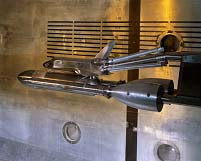 |
Langley Full Scale Tunnel – This facility performs testing on a wide variety of subjects including spacecraft, aircraft models, full scale aircraft, road signs, and NASCAR race cars. It was put into service by NACA in May 1931, and is now owned by Old Dominion University. Because of its significance to the advancement of aeronautical research, this wind tunnel has been designated a National Historical Landmark by the U.S. Department of Interior’s National Parks Service. |
 |
 |
 |
For more info on the Langley Full Scale Tunnel, visit its website at http://www.lfst.com.
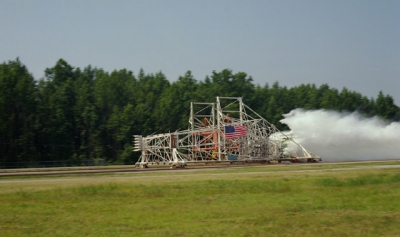
Aircraft Landing Dynamics Facility - This facility performs testing on brake systems, tires, landing gear, and different runway surfaces for both military and civilian aircraft. This facility has been used to support the STS-107 investigation.
 |
 |
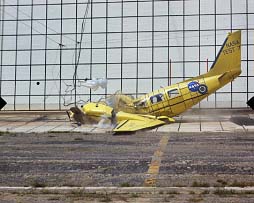
Impact Dynamics Research Facility – This facility performs crash testing on subjects including helicopters, military aircraft, and space applications. Historically, this facility was used to test the lunar landing module and for the astronauts to practice lunar landing. Both the IDRF and the ALDF will be closing at the end of this summer, so this may be the last chance to see them in action.
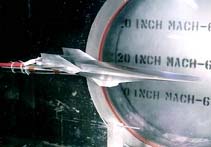
Transonic Cryogenic Tunnel - used for testing two-dimensional airfoil sections and other models at high Reynolds numbers. The adaptive walls, floor and ceiling in the test section can be moved to the free-stream streamline shape which eliminates or reduces wall effects on the model. The Mach number, pressure, temperature, and adaptive wall shapes are automatically controlled. The test section has computer-controlled angle-of-attack and traversing wake survey rake systems. Aerothermodynamics Facilities - The Aerothermodynamic Facilities Complex is a collection of four hypersonic wind tunnels utilized for basic fundamental flow physics research, aerodynamic performance measurements, and aeroheating assessment, optimization, and benchmarking of advanced space transportation vehicles. |
| The AFC includes the 15-Inch Mach 6 High Temperature Tunnel, 20-Inch Mach 6 CF4 Tunnel, 20-Inch Mach 6 Tunnel, and the 31-Inch Mach 10 Tunnel. Collectively, these tunnels provide a wide range of Mach number, unit Reynolds number, and normal shock density ratio. The AFC facilities are relatively small and economical to operate, hence ideally suited for fast-paced aerodynamic performance and aeroheating studies aimed at screening, assessing, optimizing, and bench-marking (when combined with computational fluid dynamics) advanced aerospace vehicle concepts and basic fundamental flow physics research. | 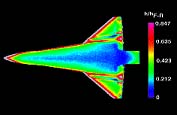 |
 |
The AFC facilities were designed and constructed in the late 1950's and early 1960's. The AFC has contributed to most major hypersonic vehicle programs including the Apollo, Viking, Space Shuttle Orbiter, National Aero-Space Plane, Pegasus XL, DC-X/Vertical Takeoff and Landing Vehicle, X-33/Advanced Technology Demonstrator, X-34/Small Reusable Booster, X-38/Experimental Crew Return Vehicle, Kistler/Small Payload to Orbit Vehicle, Reusable Launch Vehicle, and X-43. With the renewed interest in planetary and space exploration, the AFC has also contributed in this arena to the development of the Mars Microprobe, Stardust Sample Return Capsule, and Genesis. Most recently, these facilities have been used heavily to support the STS-107 investigation. |