| C&R
Technologies Thermal Desktop and RADCAD
Thermal Desktop Course
- Hands On Introductory
- Finite Difference and Finite
Element Modeling
- Heatpipes
- Air Flow
RadCAD Course
- Building a model for radiation
calculations
- Verification of models
- Finding co-planar surfaces
|
 |
| Thermal
and Fluids Analysis with Fluent
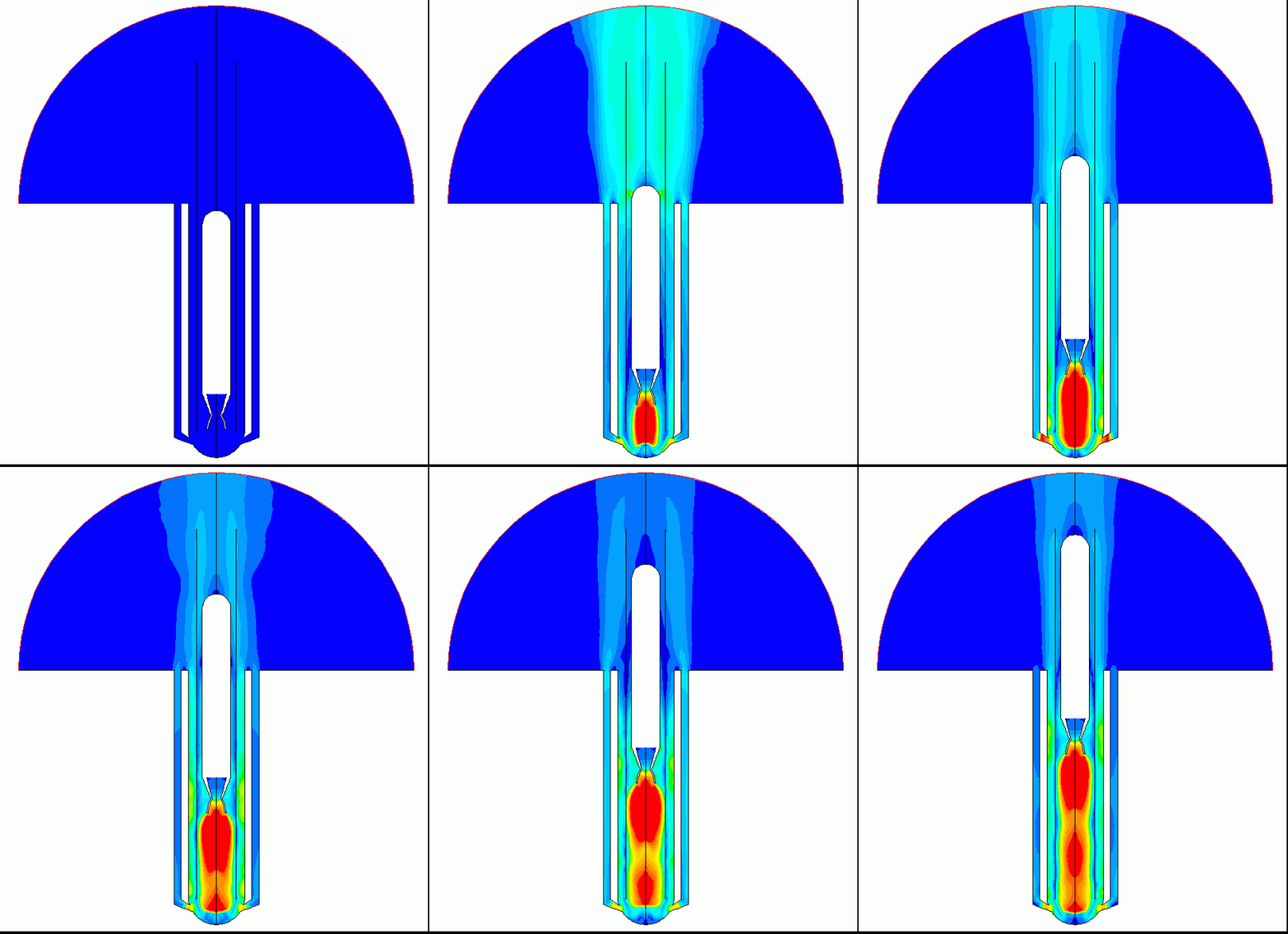
FLUENT is a CFD package for simulating single
and multiphase fluid flow, conjugate heat transfer,
combustion, and species transport in geometrically
complex systems. It is distinguished not only
by its ability to model complex physical phenomena
on unstructured, moving and deforming meshes,
but also by its client-server architecture which
enables a level of user interaction unparalleled
in the CFD industry. File I/O is largely eliminated,
enabling seamless movement between various analysis
tasks, including model set-up, visualization,
solution adaption for increased accuracy, and
reporting. Furthermore, solutions are obtained
readily: FLUENT runs in serial on a single cpu,
or in parallel on multiple cpu’s – and on a multitude
of platforms. FLUENT also utilizes the finite
volume method, known to be much more robust and
computationally efficient than finite element
solvers for high-Reynolds number flows. (Fluent
Inc. also offers finite-element flow solvers –
FiDAP and PolyFlow - for low-Re flows appearing
in chemical and materials processing applications.)
Bundled together with GAMBIT - a fully-featured
mesh generation package - and dedicated, unlimited
technical support, users can not only meet schedule
and satisfy customers’ initial requests – they
can grow their business by building a track record
of success on ever-more challenging projects.
The FLUENT short course will include a demo of
GAMBIT and FLUENT and provide hands-on instruction
on the use of FLUENT. Please contact Greg Stuckert
at 1-800-445-4454, x243 or gks@fluent.com to discuss
your specific goals and ensure that we bring tutorials
of most interest to you.
|
 |
Blue
Ridge Numerics' CFDesign
A hands-on tutorial session will be conducted
demonstrating the entire analysis and synthesis
process. The user will have an opportunity to
"drive" CFDesign, the fastest-growing CAE application
on the market. Setup of boundary conditions, property
definition, running an analysis, reviewing results,
and setting up multiple models for assessment
in the Design Review Center will be covered. Several
applications will be run by the users including
internal flow, conjugate heat transfer, and external
aerodynamics.
Come experience for yourself what can be accomplished
with CFDesign in 4 hours.
|
 |
| MAYA’s
Simulation Software: TMG / ESC
TMG is a comprehensive heat transfer simulation
package that enables a geometry-based approach
to spacecraft thermal analysis. The package allows
CAD geometry to be used productively for thermal
analysis activities, by enabling engineers to
efficiently create and mesh abstracted analysis
geometry which is derived from the detailed design.
The package offers a comprehensive and integrated
set of tools for numerical simulation of spacecraft
thermal performance, deployed within a highly
graphical and interactive modeling system. The
software incorporates powerful heat transport
modeling capabilities (finite volume conduction
scheme, discrete radiative heat transfer), sophisticated
physical models (orbital environmental heating,
fully-coupled 1-D fluid flow), data exchange (CAD
geometry import, temperature mapping, SINDA/TRASYS
interfaces), and advanced solver technology (model
substructuring, BiConjugate Gradient solver, implicit
or explicit transient schemes).
ESC provides high fidelity simulation of three
dimensional air flow and heat transfer. MAYA's
flow solver technology computes a solution to
the Navier-Stokes equations in general complex
3D geometry. It uses an element-based finite volume
method and a coupled algebraic Multigrid method
to discretize and solve the governing equations.
Physical models include laminar or turbulent incompressible
and compressible flow, natural convection and
general boundary conditions for fluid flow and
heat transfer in ducts and enclosures. Several
physical models are available. The solver uses
a state-of-the-art co-located discretization scheme
and mass-momentum terms are solved fully coupled.
Analysis time is significantly reduced through
powerful modeling technology. The software allows
the fluid and thermal mesh to be non-aligned;
the fluid flow model adapts around convecting
surfaces and flow obstructions.
This session will provide a general overview of
the features and capabilities of the packages,
and highlight specific applications of the codes
to problems in the aerospace industry. The session
will also include a summary of recent and upcoming
enhancements to the products, which include: multiple
fluids, primitives-based surface modeling, periodicity
boundary conditions, thermoelectric cooler modeling,
simulation of condensation, radiation thermal
model data exchange, surface patching for radiation
simulation, new capabilities for articulating
models.
|
 |
| MSC.Patran
Thermal
This course provides an introduction to building
thermal models and post-processing results in
MSC.Patran. The student will create an analysis
model in MSC.Patran, assign properties and boundary
conditions, and submit the analysis to MSC.Thermal.
The hands-on exercise will also illustrate the
SINDA translator and mapping of temperature results
as loads to a structural analysis with similar
or dissimilar mesh. The basic modeling process
demonstrated in this course is relevant to other
thermal preferences available in MSC.Patran.
|
 |
| Harvard
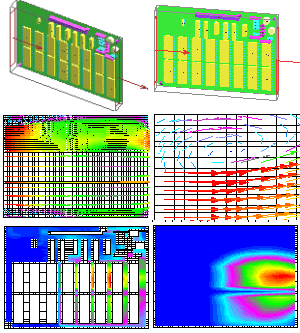
Thermal TASPCB Board Level Analysis
This course provides an introduction to importing
native ECAD files to automatically generate detailed
board models in TASPCB. Students will import board
files, map components, create thermal libraries,
and add airflow for CFD analysis or wedge locks
for conduction-cooled boards. This interactive
exercise will demonstrate the effects of vias,
and results will predict board temperatures at
any layer. Importing compact thermal models and
exporting board models to industry recognized
tools such as TAS will also be demonstrated.
|
 |
MINIVER
*****open to US Citizens only*****
MINIVER is a versatile engineering code that uses
various well-known approximate heating methods,
together with simplified flowfields and geometric
shapes to model the vehicle. Post-shock and local
flow properties based on normal-shock or sharp-cone
entropy conditions are determined in MINIVER through
user selection of the various shock shape and
pressure options. The calculations can be based
on perfect-gas or equilibrium-air chemistry. Angle-of-attack
(AOA) effects are simulated either through the
use of an equivalent tangent-cone or an approximate
crossflow option. The flow can be calculated for
either two- or three-dimensional surfaces. However,
the three-dimensional effects are available only
through the use of the Mangler transformation
for flat-plate to sharp-cone conditions. MINIVER
has been used extensively as a preliminary design
tool in government and industry and has demonstrated
excellent agreement with more detailed solutions
for stagnation and windward acreage areas on a
wide variety of vehicle configurations, including
the Space Shuttle orbiter, HL-20, X33 (winged
body, lifting body and vertical lander), X34,
X37, X43 and NASP. The principle advantage of
this engineering code over some of the more detailed
methods is the speed with which the analyses can
be performed for each flow condition along a trajectory.
Its strength lies in its ability to quickly provide
the time-dependent thermal environments required
for TPS analysis and sizing.
MINIVER is an interactive computer program which
is used both to predict the aerothermal environments
and to perform simple TPS sizings for aerospace
vehicles that operate in the hypersonic flight
regime. Three subprograms comprise the MINIVER
code: PREMIN, the preprocessor used to set up
the input; LANMIN (LANgley MINiver), used to compute
the aerothermal environments; and EXITS, used
to predict the thermal response of the TPS. MINIVER
is an engineering code, suitable for research
at the conceptual and preliminary design level.
The code was originally developed at McDonnell
Douglas circa 1970 under government contract.
It was upgraded in 1983 and again in 1988 by Remtech
Inc. under contract to NASA Langley and the Vehicle
Analysis Branch. In-house development has continued
at Langley since that time. The last official
release of the code occurred in 1991. The 2003
version (a beta release) will be “unveiled”
at the upcoming TFAWS. The code, as presently
configured, runs on a UNIX workstation, a PC,
or a Mac (both OS 9 and OS X). It is currently
used at more than 100 government, military, educational,
and aerospace industry installations throughout
the country.
|
|
|