Pro/Engineer
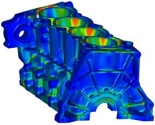
Advanced Structural & Thermal Simulation
With Pro/ENGINEER Advanced Structural & Thermal
Simulation, design engineers can: take advantage
of expert tools to simulate the behavior of parts
and assemblies subject to structural and thermal
loading, evaluate and optimize static and dynamic
structural performance of their designs, and use
unique adaptive technology to provide fast, accurate
solutions automatically.
Demo will cover advanced thermal simulation capabilities:
- Steady-state and transient thermal
analysis of parts and assemblies
- Analysis of solids, thin shells,
beams and connections
- Isotropic, transversely isotropic,
orthotropic & composite materials
- Boundary conditions including
prescribed temperature, non-linear convection,
radiation and cyclic symmetry
- Heat loads on surfaces, edges,
and points
- Automatic meshing, mesh adaptivity
and solution accuracy checking for fast and
reliable answers
- Local and global sensitivity
studies on physical dimensions, material properties,
and other Pro/E design parameters
- Automatic goal-oriented optimization
of designs
- Transfer temperature distributions
to Pro/ENGINEER Structural Simulation for thermal
stress/deformation analysis
as well as other Pro/ENGINEER analysis
tools:
- Distributed integrated
analysis process & data sharing
- Fatigue analysis
- Mechanism design synthesis
- Kinematic and dynamic motion
simulation
- Animation of assembly-disassembly
and maintenance sequences.
- Mold filling simulation
- Geometry-based optimization
|
 |
| Supersonic/Hypersonic
Arbitrary Body Program
S/HABP Overview by AFRL, NASA LaRC and Zona Tech
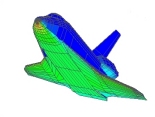
S/HABP is a supersonic and hypersonic aerodynamic
computation program that can compute the aerodynamic
characteristics of complex arbitrary three-dimensional
shapes. The original code was developed at Douglas
aircraft in 1964. The Air Force has sponsored
further development of this code under various
contracts over the years and the latest release
version is known as the Viscous Effects on Complex
configuration (VECC) code. The VECC code is actually
a graphical front end for the S/HABP Mark 5 analysis
code. The VECC user interface runs under Unix
systems with the X-windows/Motif graphics routines.
VECC allows the user to either read in geometries
prepared elsewhere or has limited built in geometry
manipulation tools to build simple geometries.
VECC then allows the user to setup the analysis
methods and flight conditions for which the user
wants aerodynamics analyzed and then run the S/HABP
code. The user can then plot the results with
a built in 2-d plotting module. The S/HABP Mark
5 code has been updated over the years and has
had several new features added. Although the program
primarily uses local-slope pressure calculation
methods that are most accurate at hypersonic speeds,
its capabilities have been extended down into
the supersonic speed range. Some of the calculations
that S/HABP can provide are inviscid aerodynamics,
viscous aerodynamics, streamlines, boundary layer
computation, shock shape/flow-field analysis,
component shielding. The S/HABP code takes as
input a paneled geometry and the run setup inputs.
The S/HABP code is extremely fast and takes on
the order of seconds for a single case to be completed.
Therefore it is extremely well suited to conceptual
level studies for high speed vehicles and is also
well suited for linking into automated design
environments.
To obtain a copy of the VECC & S/HABP codes please
send a request to AIR FORCE RESEARCH LAB, AFRL/VAAA,
2130 8th St., Wright-Patterson AFB, OH 45433.
ZONAIR by ZonaTech is a versatile tool that is
coupled to S/HABP for rapid aerodynamic database
generation. Its capabilities include: aerodynamic
AIC matrix readily coupled with FEM, force/moment
coefficients, multi-body interference aerodynamics,
and accurate aerodynamics for aeroheating prediction.
|
 |
Amtec
Engineering’s Tecplot
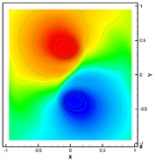
Tecplot is plotting software with extensive 2-
and 3-D capabilities for engineering and scientific
data visualization.
Every journey to the top of a mountain takes a
different route, but the reward is always the
same: an amazing view. When you’re scaling
a mountain of data you want to see the most informative
views – the ones that show the trends, the
anomalies and the physics in your data.
The next time you embark on an engineering or
scientific project – be it simulation, analysis
or experiment – count on Tecplot, the plotting
and visualization software that helps present
your work in its best light. And when you think
of a new, better, or different way to present
your data, Tecplot gives you full control over
2- and 3-D plot parameters. Conquer your mountains
of data and when you reach the top... Enjoy the
View.
Tecplot Demonstration:
- Animations
- Macros
- Automation
- CFD Analyzer’s Integration
Module
- Extracting and Displaying Shock
Surfaces and Vortex Cores
- Creating Particle Paths
New Features in Tecplot 10 Demonstration:
- Better Data Management
- Data Journaling
- Variable & Node Map Sharing
- Auxiliary Data
- New Data Structures
- New Plot Types
- More Ways to Enjoy your Data
- Specular Highlights
- Multiple Contour Variables
- RGB Color Flooding
- 3D Scatter Symbols
- Image Import
- Ease and Convenience Enhancements
- Undo
- More Frame Linking Capabilities
- Improved Data Loaders
|
 |
| Spacedesign
TSS and FEM
Spacedesign’s products, that provide Enterprise
Engineering Solutions, consist of the industry
workhorse Thermal Synthesizer System (TSS) that
provides Thermal Analysis and two new applications
called MESH and Finite Element Method (FEM) that
provide Structural Analysis.
The following enhancements and/or capabilities
of TSS and FEM will be discussed: Computational
Geometry in Thermal Analysis, Integrated Structural
and Thermal Analysis, and Thermal and Structural
Part Analysis.
|
 |
Wolfram
Research, Inc. Presents Mathematica 5
Wolfram Research technical staff will give an
overview of the features and capabilities of Mathematica
5. This lecture not only will be accessible to
people who have never used Mathematica but also
will be of interest to current Mathematica users.
|
 |
| Viscous
Upwind Algorithm for Complex Flow Analysis
VULCAN Overview by NASA LaRC
VULCAN, named for the Roman god of fire, is a
multi-grid, multi-block, structured, finite-volume
code, developed for solving the spatially elliptic
and parabolized forms of the equations governing
three-dimensional, turbulent, calorically perfect
or non-equilibrium chemically reacting flows.
Space marching algorithms developed to improve
convergence and/or reduce computational cost are
implemented as well as elliptic methods for solving
flows with large regions of subsonic flow. A full
approximate storage, full multi-grid scheme is
also implemented to accelerate convergence of
either the elliptic or space marching schemes.
The governing equation can be integrated using
either an implicit psuedo-time stepping algorithm
(for steady state solutions) or an implicit dual-time
stepping algorithm (for unsteady solutions). Compressibility
corrected forms of the k-epsilon and k-omega,
two-equation turbulence models are implemented
that are suitable for high speed flows. In addition,
compressible, pressure gradient corrected turbulent
law-of-the-wall matching function are implemented
that decreased wall grid spacing sensitivity.
Chemistry/turbulence interaction models are also
implemented using either eddy breakup or assumed
probability density function (PDF) methods.
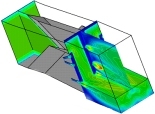
For more information about VULCAN see:
|
 |
| Network
Analysis, Inc.
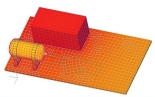
Graphical Model Builders for Thermal Design
SINDA thermal models can be built using network
models or geometric model builders. There are
two basic types of geometric model builders, those
that use shapes (i.e. cylinders, rectangles, spheres,
etc) and those that mesh geometry into finite
elements. Each technology has advantages and disadvantages.
This demonstration will show the transparent integration
of SINDA/G into both types and discuss how to
combine the best features of both for thermal
design.
The demonstration will show thermal modeling with
the following products: MSC.Patran, FEMAP, Thermica,
and MS Visio for network type thermal model building.
|
 |
Conjugate
Heat Transfer with CD adapco Group's STAR-CD
STAR-CD is a full featured commercially available
CFD package that handles the most complex of cell
topologies and mesh types. The STAR-CD solver
readily handles fully unstructured grids while
offering a broad range of physical models, discretization
schemes, solver algorithms including Algebraic
Multi-Grid for accelerated convergence, and high
fidelity turbulence models for full resolution
of the near-wall region. These capabilities, combined
with the full parallel capabilities of the solver,
make STAR-CD a versatile tool for Heat Transfer
and Fluid Flow calculations.
In addition to offering a robust meshing and solver
package, the people behind STAR-CD would like
to demonstrate at TFAWS 2003 our new suite of
tools for making CFD and Heat Transfer analysis
simple, powerful, and efficient. At the conference,
we will demo STAR-Design, a single CAE environment
for creating geometries, automatic meshing, pre-processing,
solving, and post-proprocessing. The parametric
basis of the CAD model distinguishes this tool
from other CAE/CFD packages; the user may change
the CAD geometry and review the flow results in
a single click. At TFAWS, these capabilities will
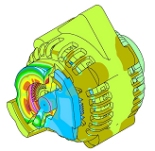
be demonstrated as we model a cooled part subjected
to hot external flow. Our goal is to show that
the STAR-CD family provides a powerful and complete
toolbox for the Heat Transfer and Fluid Flow analyst.
|
 |
|