|
Thermal and Fluid Analysis
– Current State and Vision of the Future
| Oktay Baysal is an Eminent
Scholar and (tenured, full) Professor (1992) of
Aerospace Engineering (and formerly of Mechanical
Engineering and Mechanics) at Old Dominion University.
Dr. Baysal's research interests are in the areas
of computational fluid dynamics, design optimization
and sensitivity analysis, unsteady aerodynamics,
computational aeroacoustics, and micro-fluidic transport
in micro-electro-mechanical systems. He has authored
or co-authored one hundred and twenty technical
publications (full-length), and edited or co-edited
ten technical books. His research projects have
been extensively sponsored by various funding agencies
and the industry. |
 |
Currently, he is serving as the interim
dean of the college of engineering and technology at
Old Dominion University. As the associate dean for research,
he provides the linkage to and from the college's "Enterprise
Centers" and the university's "Research Foundation"
to the faculty and students of the college. He manages
the budget for the research and teaching assistant stipends
and scholarships for their tuition. The unique feature
of these centers is their catalytic role in intermeshing
the disparate research metrics and cultures between
the academe, industry and government laboratories. Dr.
Baysal has also served in many other roles, such as
Director of the Engineering Fundamentals Division and
Associate Editor of th Journal of Fluids Engineering.
In 1993, he was awarded the NASA Public Service Medal
for "exceptional contributions to NASA's basic
research and technology program through personal research
and the direction of graduate research." He also
has received two NASA Certificates of Recognition for
"disclosing an inventive contribution," and
for "the creative development of a scientific contribution
that has been determined to be of significant value
in the advancement of NASA's aerospace technology program."
Oktay Baysal received his B.S. (1977) from Istanbul
Technical University, M.S. (1978) from The University
of Birmingham, England, and Ph.D. (1982) from Louisiana
State University.
Dr. Baysal will present his ideas about
the current state of thermal and fluid analysis, as
well as provide meaningful insight as to what the future
will bring. He will discuss where the analysis field
is headed, what the perceived trouble areas or big hurdles
that must be cleared are, as well as the strengths of
analysis and what its perceived major role in the future
is.
|
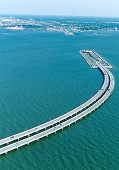
Construction of a Bridge
Tunnel
|
|
| Mr. Dangerfield currently
serves as the Facility Manager for the Monitor-Merrimack
Memorial Bridge Tunnel (MMMBT), which cost $400
million to build and includes a 4,800-foot long
four-lane tunnel, two man-made portal islands, and
3.2 miles of twin trestle. Prior to his current
position he served as an inspector for the MMMBT
during the construction phase. |
 |
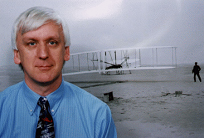
An Analysis of the 1903
Wright Flyer
| Dr. Britcher currently
serves as an Associate Professor of Aerospace Engineering
at Old Dominion University (ODU). His duties include
direction of research and academic programs at the
Langley Full-Scale Tunnel, the largest University-operated
wind tunnel in the world, and leadership of the
master's degree program in Experimental Methods. |
 |
He was educated at the University of
Southampton, England, earning Bachelor's and Doctoral
degrees in 1978 and 1983 respectively. After a two-year
residence at NASA Langley Research Center as an NRC
Associate, he joined ODU. He has authored over 50 technical
publications covering these areas and has received research
funding totaling over $2 million. He is an Associate
Fellow of the American Institute of Aeronautics and
Astronautics, and a member of SAE and the American Society
of Engineering Education.
He will present an analysis of the 1903
Wright Flyer, based on new data for aerodynamic and
propeller characteristics, together with accepted historical
data for the engine, weather conditions, weights, and
dimensions. It is found that the flight performance
was extremely marginal, that the flyer may have been
essentially limited to operation in ground effect, and
that take-off may have been impractical without a headwind.
Further, it is shown that commonly accepted values for
in-flight engine/propeller RPM may be underestimates.
This analysis highlights the Wright Brothers prowess
at systems integration, which resulted in their successful achievement of flight
with very little margin for error.
Lessons
Learned from the Columbia Accident Investigation
| Mr. Bradley is responsible
for the overall review and technical readiness of
all NASA programs. Bradley assures development efforts
and mission operations are planned and conducted
on a sound engineering basis, and provides an integrated
focus for agency-wide engineering policies, standards
and practices. Bradley is a former nuclear engineer
for the U.S. Navy, serving in the Naval Nuclear
Propulsion Program. He has also served as a civilian
with the U.S. Department of Energy and the Department
of Defense in numerous leadership and management
positions with the Office of Naval Reactors, both
in Washington and in the Idaho branch. Bradley is
currently serving as the Executive Secretary for
the Columbia Accident Investigation Board. |
 |
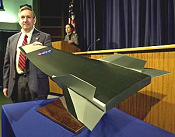
X-43 program and scramjet
engine development and testing
| NASA's Hyper-X Program
is a joint effort between NASA Langley Research
Center and NASA Dryden Flight Research Center to
demonstrate scramjet (supersonic combustion ramjet)
propulsion in flight at Mach 7 and Mach 10. This
joint effort involves flying a small (12 feet long)
scramjet powered demonstrator vehicle (X-43A). The
Hyper-X program is the first step in a multi-year
effort to enable both cheaper, safer, and very routine
access to space as well as high-speed flight in
the atmosphere. |
 |
|