
Keynote Speakers
Wednesday, August 28, 2024
Dr. James A. Kenyon
Center Director, NASA Glenn Research Center (GRC)
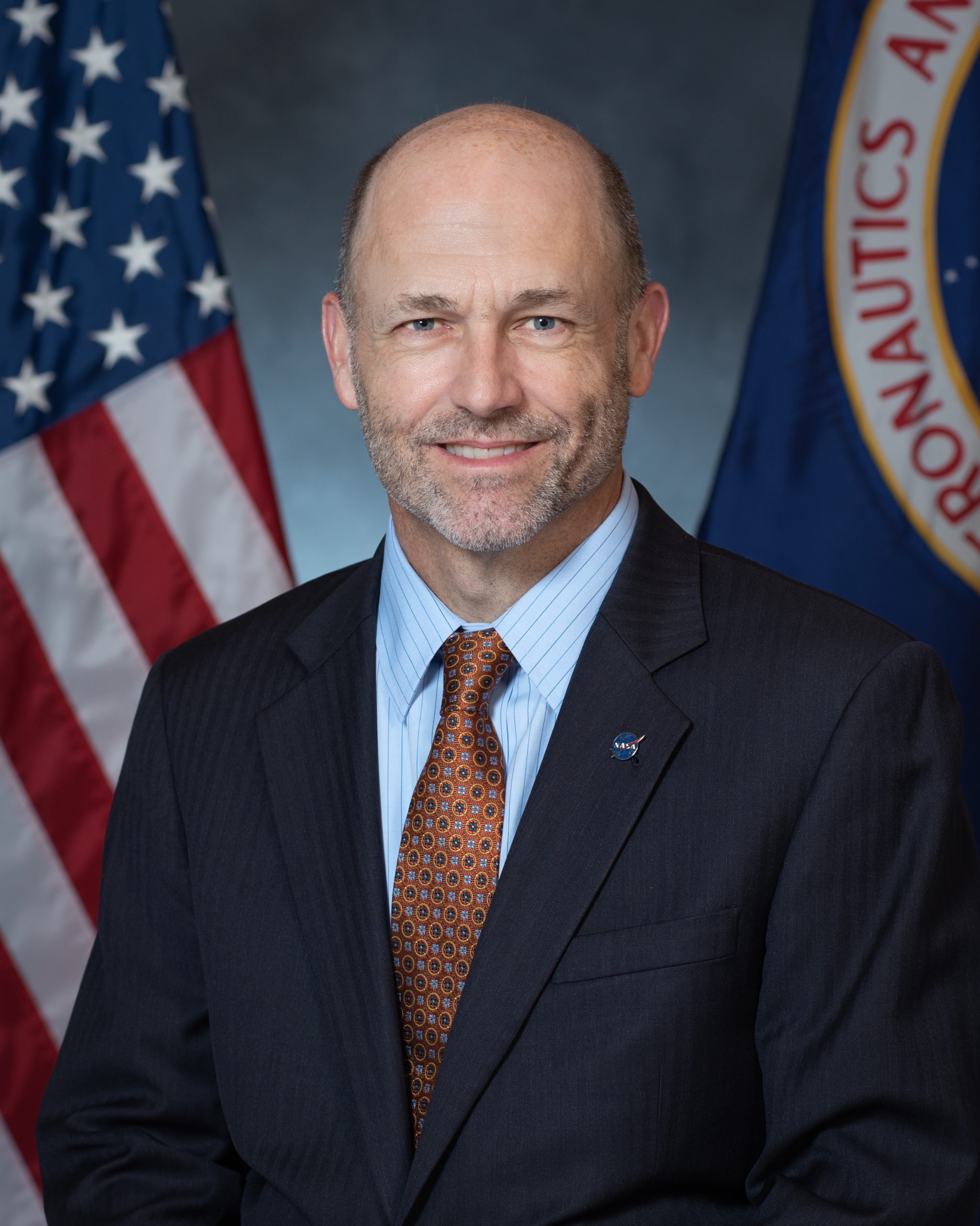 Dr. James A. Kenyon is director of NASA’s Glenn Research Center in Cleveland. He is responsible for planning, organizing, and directing the activities required to accomplish the missions assigned to the center. Glenn has a staff of more than 3,200 civil servants and support service contractors and an annual budget of approximately $900 million.
Kenyon is a Fellow of the American Institute of Aeronautics and Astronautics and of the Royal Aeronautical Society. He received a bachelor’s degree in aerospace engineering from Georgia Tech, a master’s degree in mechanical engineering from Purdue University, and a doctorate in mechanical engineering from Carnegie Mellon University.
Prior to becoming Glenn’s director, Kenyon served as director of the Advanced Air Vehicles Program in the Aeronautics Research Mission Directorate (ARMD) at NASA Headquarters in Washington. He was responsible for the overall planning, management, and oversight of the directorate’s efforts to develop innovative concepts, technologies, and capabilities to enable revolutionary advances for a wide range of air vehicles. He supported the mission directorate and the ARMD associate administrator in a broad range of activities, including strategic and program planning, budget development, program review and evaluation, and external coordination and outreach.
Prior to joining NASA, Kenyon worked with Pratt & Whitney, where he held key leadership roles in business development, program management, and engineering, including serving as executive director of advanced programs and technology. Dr. Kenyon joined Pratt & Whitney after 17 years as a civilian in the Department of Defense (DoD), including six years in the Office of the Secretary of Defense, where he was responsible for strategic planning, policy guidance, and management oversight of DoD aerospace science and technology programs.
Trudy Kortes
Director of Technology Demonstrations, NASA Space Technology Mission Directorate (STMD)
 Ms. Trudy F. Kortes serves as the Director of Technology Demonstrations for NASA’s Space Technology Mission Directorate, managing more than $500M annually for the Agency to accomplish key technology advancements for future science and human exploration missions for the Agency and nation. Most recently, Trudy served as the Chief of the Human Exploration & Space Operations Division at Glenn Research Center in Cleveland, Ohio. In that role she had oversight for over $200 million annually in key agency work in the testing of the Orion spacecraft, the Space Launch System universal stage adapter, Human Research Program elements such as exercise devices, International Space Station biological and physical sciences, and advanced communications systems such as cognitive and quantum communications. From 2015 to 2018, Trudy served as the Technology Demonstration Missions Program Executive and managed the growing portfolio of flight and ground demonstration projects. Under her leadership, the program successfully developed important technology flight demonstrations, including the Laser Communications Relay Demonstration, the Green Propellant Infusion Mission, Deep Space Atomic Clock, and the STMD technology investments onboard the Mars Perseverance rover. She has over 28 years of experience at NASA holding various institutional and programmatic positions at the Johnson Space Center, Ames Research Center, Glenn Research Center, and NASA Headquarters. Ms. Kortes is a federally certified program and project manager and has extensive experience in key systems engineering roles. She resides in Westlake, Ohio with her husband and three children.
Lunch Session Speakers
Monday, August 26, 2024
Logan Larson
European Service Module (ESM) Integration Office (EIO) Systems and Mission Integration Manager
 Logan Larson is the European Service Module (ESM) Integration Office (EIO) Systems and Mission Integration Manager, where he is responsible for oversight and integration of the various non-propulsion ESM systems and mission operations and planning. He started at NASA 11 years ago within the propulsion team, where he acted as the feed system lead and interface with the thermal team for propulsion equipment. He has had roles as the Orbital Main Engine (OMS-E) and Thrust Vector Control (TVC) Project Manager, and most recently as the ESM Deputy Chief Engineer, where he supported on console for Artemis I. He received his bachelors degree from Michigan State University in Mechanical Engineering and masters degree from Purdue University in Aerospace engineering.
Tuesday, August 27, 2024
David L. Stringer (Brig. Gen. Ret.)
Director, NASA Neil A. Armstrong Test Facility
 David L. Stringer is director of Neil A. Armstrong Test Facility in Sandusky, Ohio, a 6,400 acre remote test site 50 miles west of Cleveland, for the National Aeronautics and Space Administration’s Glenn Research Center in Cleveland, Ohio. Appointed to this position on Feb. 18, 2007, Stringer synchronizes activities at the world-class installation to support critical research and development for NASA, the Department of Defense and commercial industry to advance space exploration and global aeronautic leadership.
Stringer retired from the United States Air Force on Jan. 1, 2007, as a brigadier general. He was the first maintenance officer assigned to the 4477th Test and Evaluation Squadron, which flew three types of Soviet aircraft to prepare American aircrews for combat. Stringer commanded a squadron in England and a group in Italy before his final assignment as commander, Arnold Engineering Development Center, Arnold Air Force Base, Tennessee. He was stationed six times overseas for a total of 12 years and supported the 1995 air war over Bosnia as well as the 1999 Kosovo War in the Balkans.
Stringer holds a Bachelor of Science in foreign service from Georgetown University and a Master of Arts in history from the University of Alabama. He was one of 12 selected annually in the Department of Defense to attend Harvard’s John F. Kennedy School of Government as a National Security Fellow.
Stringer is a published author, cited in numerous professional publications and journals, including the Wall Street Journal and Aviation Week and Space Technology. His awards include the University of Alabama’s award for research and writing and many defense awards.
Wednesday, August 28, 2024
Derrick J. Cheston
Chief, Systems Engineering and Architecture Division, NASA GRC
 Derrick J. Cheston is a senior executive in the National Aeronautics and Space Administration (NASA) who leads the Systems Engineering and Architecture Division at the Glenn Research Center. Derrick began his NASA career immediately after college and has been with the Agency 40-years.
He first supported engineering design and development for both space and aeronautics in structures, thermal and fluids areas and contributed to the one of the GRC’s first in-house microgravity science experiment – the Surface Tension Driven Convection Experiment. Mr. Cheston moved into supervisory leadership roles early in his career as a branch supervisor in the thermal and fluids design and analysis area, supporting flight systems and technology development efforts including aeronautics and space technology hardware as well as microgravity science payloads. In that capacity he is proud of his role in helping to grow TFAWS as a model for collaboration and teamwork within the Agency where all Centers win.
As one of the founding members of the NASA Engineering and Safety Center (NESC) in 2003 he was the first NESC Chief Engineer for GRC, responsible for providing technical independence and technical excellence in support of critical Agency flight safety decisions. There he provided critical engineering assessments for the Ares I-X Upper Stage Simulator.
Derrick was appointed to the Senior Executive Service (SES) in 2009 as the Chief of the Mechanical Systems Division, and since 2014 has led the Systems Engineering and Architecture Division, which plays a critical role in the development of space and aeronautics flight and technology demonstration projects such as Artemis-I, Electrified Powertrain Flight Demonstration and the Power and Propulsion Element for Gateway.
Mr. Cheston earned a BS in Aerospace Engineering from North Carolina State University and both an MBA and a MS Mechanical Engineering from Cleveland State University. Mr. Cheston was born and grew up in rural Warren County, North Carolina. He currently resides in Woodmere, Ohio with his wife, Sharon and has 3 adult children and two grandchildren.
Thursday, August 24, 2023
Douglas N. Lantry, Ph.D.
Curator and Historian, National Museum of the United States Air Force
 Dr. Doug Lantry has been a curator at the National Museum of the U.S. Air Force, Wright-Patterson Air Force Base, Ohio, USA, since 2000, and also serves as the museum’s historian. His curatorial focus areas include space and missiles, strategic nuclear deterrence, the First World War, the Korean War, and the Southeast Asia War. He received his Ph.D. in the History of Technology with a certificate in Museum Studies from the University of Delaware as a fellow in the UD-Hagley Program in the History of American Industrialization. He also is a retired U.S. Air Force Reserve historian, serving at Headquarters U.S. Air Force and U.S. Strategic Command, with deployments supporting operations in Afghanistan, Iraq, Kuwait, and Qatar.